



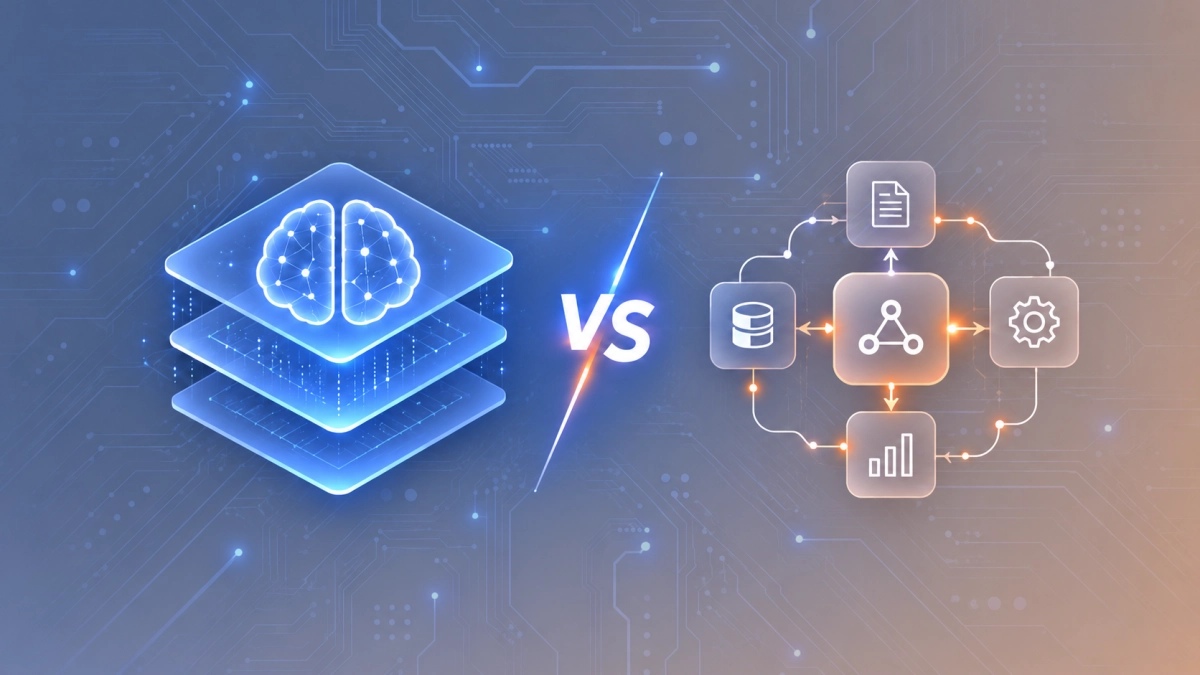
AI Native vs AI Agents is a question enterprise leaders need to answer before investing in their next AI initiative. Should you build products and services with AI at their core, or deploy AI agents that can take on tasks, coordinate workflows, and reduce manual effort? Get this decision right, and AI can become more than another technology investment. It can change how your business operates, makes decisions, and delivers value.
An AI-native product, service, or business is built from the ground up with artificial intelligence as its core foundation, rather than having AI added as an afterthought. AI agents, in contrast, are designed to pursue specific goals by gathering information, using connected tools, and carrying out tasks within defined boundaries.
The two approaches are not mutually exclusive. Enterprises can build AI-native solutions that incorporate agents to coordinate workflows across business systems. They can also introduce AI agents into existing technology environments without rebuilding everything from scratch.
The real question is not which technology is more advanced. It is which approach solves your business problems most effectively. In this guide, we’ll explore the key differences between AI-native and AI agents, examine practical enterprise use cases, and help you choose the right approach based on your business goals, technology readiness, and long-term AI strategy.
Why Businesses Are Paying Attention to AI-Native Systems and AI Agents
Enterprise AI adoption is moving beyond experimentation, but scaling AI across an organization remains a challenge. Businesses need to determine where AI can deliver measurable value, how it should interact with existing systems, and what level of autonomy is appropriate for each task.
According to McKinsey’s State of AI 2026 report, 44% of respondents said their organizations were scaling AI across the enterprise, up from 38% a year earlier. Among respondents from organizations with annual revenues exceeding $1 billion, 40% reported scaling AI agents in at least one business function, compared with 27% in the previous year.
These findings suggest that large enterprises are increasingly moving toward operational AI deployments. However, adopting AI tools and redesigning business processes around AI are two different things.
For example, a company might introduce an AI assistant to help employees find information faster. Another might redesign its customer service platform around AI and deploy agents to investigate customer issues across multiple systems. Both approaches use AI, but their objectives and implementation requirements differ.
Understanding the distinction between AI-native systems and AI agents helps organizations decide where to invest, what to build, and how to scale responsibly.
What Is AI-Native Technology?
AI-native technology refers to a product, service, platform, or business built from the ground up with artificial intelligence as a core foundation. Instead of treating AI as an optional feature added to an existing offering, AI-native design makes AI central to how the offering is created, delivered, and improved.
For enterprises, this can involve more than introducing intelligent features into an existing application. It may mean rethinking a product’s capabilities, redesigning a service delivery model, or building a business offering around AI-driven intelligence and automation.
Consider an enterprise analytics platform. A conventional platform might rely on predefined dashboards and reports that employees must interpret themselves. An AI-native platform could be designed around natural-language queries, predictive insights, contextual recommendations, and intelligent workflows from the beginning.
Similarly, an AI-native service could use AI throughout its delivery process rather than relying on it for just one isolated task.
The key distinction is not whether a business uses AI. It is whether AI is fundamental to the way its product, service, or business is designed to deliver value.
Key Characteristics of AI-Native Technology
Although AI-native products, services, and businesses can take different forms, they share a common principle: AI is built into the core design rather than treated as an optional add-on.
Key characteristics include:
- AI-first design: AI influences the core architecture, product strategy, or service delivery model from the beginning.
- Context-aware intelligence: The system uses relevant data, business rules, and context to produce useful insights or recommendations.
- Integrated capabilities: AI is incorporated into core workflows instead of being isolated in a separate tool or feature.
- Adaptability: The offering can evolve as models, data, business requirements, and user needs change.
- Business alignment: AI capabilities are designed around specific outcomes, such as improving decision-making, enhancing customer experiences, or reducing operational friction.
These characteristics do not mean every AI-native product or service operates autonomously. Some focus on insights and recommendations, while others incorporate automation or AI agents to execute tasks.
Examples of AI-Native Products, Services, and Platforms
AI-native design can support a range of enterprise use cases.
- Customer service platforms: AI is built into the core experience to understand customer requests, retrieve information, and guide service interactions.
- Business intelligence platforms: Users can investigate performance changes, identify patterns, and explore forecasts through AI-driven analysis.
- Healthcare services: AI supports appropriate administrative or information-management workflows, with safeguards for sensitive data and clinical decisions.
- Enterprise productivity solutions: AI helps users organize information, summarize documents, and make decisions within existing business processes.
- AI-native business services: An organization designs its service delivery model around AI-driven analysis, automation, and human expertise rather than adding an AI feature to an otherwise unchanged process.
The common thread is that AI shapes how the offering delivers value. However, a system that interprets information or recommends an action does not necessarily execute a complete task independently.
That is where AI agents become relevant.
What Are AI Agents?
An AI agent is a software system designed to pursue a defined goal by interpreting information, selecting actions, and using available tools to complete tasks.
Depending on its design, an agent may break a goal into smaller steps, retrieve information from business systems, evaluate results, and adjust its approach when something changes.
For instance, an AI-powered customer support assistant might explain the status of a delayed order. An agent could be configured to retrieve order details, check approved delivery systems, identify the appropriate escalation path, and prepare a support ticket.
The agent’s actual capabilities depend on its tools, permissions, instructions, and operating environment. It should not be assumed to have unrestricted access or the ability to make every decision independently.
How AI Agent Architecture Works
A typical AI agent architecture includes several connected components that allow the agent to move from a goal to an action.
- Goal and instructions: Define the task, expected outcome, and boundaries within which the agent must operate.
- Reasoning and planning: Determine the steps required to complete the task and select appropriate actions.
- Tools and integrations: Connect the agent to approved APIs, databases, enterprise applications, and other systems.
- Context and memory: Supply relevant information from the current task or permitted historical context.
- Evaluation and feedback: Check whether an action succeeded, identify errors, and determine whether another step is required.
- Guardrails and oversight: Enforce permissions, approval requirements, data access restrictions, and escalation rules.
Not every agent uses these components in the same way. Some follow relatively structured workflows, while others can plan across multiple steps and respond to changing conditions.
The important point is that an agent is designed to do more than generate an answer. It can use permitted tools to move a task toward completion.
Enterprise AI Agent Use Cases
Enterprise AI agents can support workflows involving multiple steps, systems, or decisions.
Common AI agent use cases include:
- IT operations: Investigating alerts, gathering diagnostic information, and preparing remediation actions for approval.
- Customer support: Retrieving case details, checking relevant policies, drafting responses, and routing complex issues to the appropriate team.
- Finance: Collecting invoice information, identifying discrepancies, and routing exceptions for review.
- Human resources: Answering employee questions, retrieving approved policy information, and initiating eligible administrative workflows.
- Supply chain: Monitoring exceptions, gathering supplier or shipment information, and recommending corrective actions.
These are potential applications rather than guaranteed outcomes. Successful deployment depends on data quality, system integrations, workflow design, and controls around consequential decisions.
AI Native vs AI Agents: What Is the Difference?
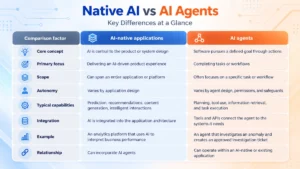
The most important distinction is that AI-native describes how a product, service, platform, or business is fundamentally designed, whereas an AI agent is a system or capability that pursues goals through actions and tool use.
AI-native describes the broader approach to creating value with AI. Agents describe one way AI can perform work within that environment.
An AI-native product may incorporate several AI capabilities, including one or more agents. An agent can also operate inside an existing application that was not originally designed around AI.
The following table highlights the practical differences.
AI-Native Architecture vs. AI Agent Architecture
AI-native architecture focuses on how AI capabilities are incorporated across a product or platform. It considers data access, model integration, user experience, application services, security, monitoring, and scalability.
An AI-native enterprise platform might combine predictive models, natural-language interfaces, retrieval systems, and agents within one consistent experience.
AI agent architecture, by comparison, focuses on how an agent receives a goal, gathers relevant context, chooses actions, interacts with tools, and evaluates the result. It must also account for execution limits, error handling, and human approval.
For example, an AI-native customer service platform might provide a unified interface for customer history, policies, and case management. An agent within that platform could retrieve a customer’s order details, investigate a delay, and prepare a case update.
The application provides the broader environment. The agent performs a specific task within it.
This relationship is important when evaluating AI orchestration, which coordinates AI models, agents, tools, and workflows so that they can work together. Effective orchestration can help enterprises manage dependencies, monitor execution, and maintain appropriate control over automated actions.
Key Enterprise Use Cases: When to Use Each Approach
The right choice depends on the business problem, not simply on which technology appears more advanced.
When AI-Native Design Makes Sense
AI-native design is a strong option when AI needs to be central to the product, service, or platform experience.
Consider this approach when:
- You are building a new product or service in which AI will shape core functionality.
- Users need AI-driven insights or recommendations throughout their workflows.
- Several AI capabilities must work together within one consistent experience.
- You want to reduce dependence on disconnected AI tools.
- AI functionality needs to be considered from the start of architecture and product development.
For example, a business developing an intelligent analytics platform might embed natural-language queries, anomaly detection, forecasting, and AI-generated explanations directly into the product.
The goal is to make AI an integral part of how users access and interpret information, rather than an optional feature they must seek out separately.
When AI Agents Make Sense
AI agents are particularly useful when a process involves multiple steps, requires interaction with business systems, or needs to move a task toward a defined outcome.
Consider agents when:
- Employees repeatedly perform the same multistep tasks across applications.
- A workflow requires gathering information from several approved sources.
- A task involves evaluating conditions before selecting an action.
- Existing systems already support the process but need an intelligent coordination layer.
- You want to automate selected activities while retaining human approval for sensitive decisions.
For example, an IT operations team could use an agent to gather information from monitoring tools, review relevant troubleshooting documentation, and prepare a recommended response to an alert.
The agent can reduce manual investigation, while the team retains control over high-impact remediation.
This is where AI workflow automation can create value. Rather than automating only an isolated step, an agent can coordinate multiple approved actions within a larger process. The value depends on whether the workflow is reliable, sufficiently well-defined, and worth automating.
When Both Approaches Work Together
In many enterprise scenarios, AI-native design and AI agents are complementary.
Imagine a manufacturer using an AI-native operations platform to monitor equipment performance. The platform identifies an unusual pattern that may indicate a machine fault.
An AI agent could then:
- Retrieve the relevant equipment history and maintenance records.
- Review approved diagnostic information.
- Summarize the likely issue and supporting evidence.
- Prepare a maintenance request.
- Route the request for approval before any consequential action is taken.
The AI-native platform provides the broader monitoring and decision-support experience. The agent handles the multistep investigation and workflow.
This is an illustrative scenario, not a claim about a specific deployed customer solution. The same pattern can apply to customer service, finance, supply chain, and IT operations.
A Practical Framework for Choosing the Right Approach
Before investing in AI-native development or AI agents, evaluate the problem against five factors.
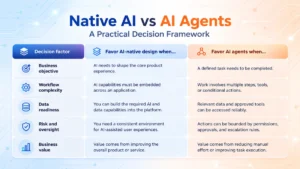
These are decision guidelines rather than strict rules. An organization may need both approaches, or it may find that conventional automation is sufficient for a predictable process.
A Three-Stage Implementation Example: AI-Native Healthcare Supply Chain
Consider a pharmaceutical company managing temperature-sensitive medicines across multiple warehouses and distribution centers. Demand fluctuations, inventory shortages, and transportation delays can disrupt deliveries, potentially affecting medicine availability and timely patient treatment. An AI-native supply chain system combined with AI agents can help address these challenges.
Stage 1: Build an AI-native supply chain environment. The system continuously analyzes demand patterns, inventory levels, supplier performance, and transportation data to predict shortages and identify potential disruptions before they affect medicine availability.
Stage 2: Introduce specialized AI agents. A demand forecasting agent identifies potential shortages, an inventory agent locates available stock across warehouses, and a logistics agent evaluates alternative transportation options. A compliance agent can also flag potential storage or temperature violations.
Stage 3: Connect agents through AI orchestration. When a potential medicine shortage is detected, the agents coordinate to identify available inventory, evaluate suitable transfer options, and recommend a distribution plan. Authorized personnel review and approve critical actions before execution.
This approach combines AI-native intelligence with the task execution capabilities of enterprise AI agents. More importantly, it can help healthcare organizations improve medicine availability, reduce the risk of stockouts, maintain cold-chain integrity, and support more timely access to essential treatments. Businesses can measure its impact through inventory availability, forecast accuracy, delivery times, stockout rates, and cold-chain compliance.
Benefits, Risks, and Governance Considerations
Both AI-native systems and AI agents can improve business processes, but neither guarantees better outcomes simply by being deployed. Results depend on the business problem, implementation quality, adoption, and the controls surrounding the technology.
Potential Benefits
- Improved productivity: AI can reduce time spent searching for information, preparing documents, and completing repetitive work.
- Better access to insights: AI-native products and services can make complex business information easier to interpret and use.
- More efficient workflows: Agents can coordinate permitted actions across connected systems.
- Consistent processes: Defined workflows and controls can help standardize routine activities.
- Scalable AI experiences: Well-designed platforms and services can support additional use cases as business needs evolve.
Organizations should measure these benefits against a baseline rather than assuming that adding AI will automatically improve performance.
Risks Businesses Need to Address
AI systems can generate inaccurate information, retrieve unsuitable context, misinterpret instructions, or take inappropriate actions if their boundaries are poorly designed. Agents introduce additional operational considerations because they may interact with business systems and execute actions.
Organizations should address the following risks:
- Data security: Limit access to sensitive information and apply appropriate identity and access controls.
- Unreliable outputs: Evaluate performance against realistic business scenarios and monitor failures.
- Excessive autonomy: Restrict actions according to risk and require approval for consequential decisions.
- Integration failures: Handle API errors, incomplete data, timeouts, and unexpected system responses.
- Limited accountability: Maintain logs and make it possible to trace important actions and decisions.
- Uncontrolled costs: Monitor model usage, infrastructure requirements, and the ongoing cost of maintaining workflows.
Why AI Governance Matters
Governance is especially important as agents move from experimentation into operational systems.
According to Deloitte’s 2026 State of AI in the Enterprise research, only 21% of surveyed organizations reported having a mature governance model for agentic AI. The survey covered 3,235 IT and business leaders across 24 countries.
This finding highlights a gap between growing interest in AI agents and the organizational controls needed to manage them.
Governance should be part of the design and deployment process, not a final checkpoint. Businesses should define what an AI system can access, which actions it can perform, when approval is required, and how errors will be detected and handled.
For AI agents, practical safeguards include permission-based tool access, transaction limits, audit logs, human escalation paths, and clear stop conditions. Organizations should also test agents against unsuccessful tool calls, ambiguous instructions, unexpected inputs, and attempts to exceed their permissions.
For AI-native products and services, governance should extend across model selection, data handling, user permissions, output evaluation, monitoring, and the product lifecycle.
The objective is not to eliminate autonomy. It is to make AI capabilities reliable, observable, and appropriate for the business context.
The Future of Enterprise AI: From Intelligent Products to Agentic Workflows
Enterprise AI is moving beyond isolated chat interfaces and standalone automation tools. Businesses are exploring ways to integrate intelligence into products and services and use agents to coordinate work across systems.
AI-native design provides a foundation for making AI a consistent part of how an offering delivers value. AI agents can add the ability to pursue defined goals and execute multistep workflows.
The broader opportunity extends beyond software features. Enterprises may redesign service delivery, rethink internal processes, and develop new offerings around AI capabilities. At the same time, agentic AI systems can help coordinate tasks that previously required employees to move between multiple tools and applications.
However, greater autonomy is not always better. Some workflows are best served by conventional automation, while high-risk decisions may require human judgment. The objective is to match the level of intelligence and autonomy to the business problem.
Organizations that establish clear objectives, reliable data access, measurable success criteria, and appropriate governance will be better positioned to turn AI experimentation into practical results.
Turn Enterprise AI Opportunities Into Measurable Business Outcomes
Choosing between AI-native design and AI agents is not just a technology decision. It is an opportunity to rethink how people, data, and business systems work together.
The most effective starting point is a clearly defined business problem. Identify where employees spend unnecessary time, where decisions lack useful context, and where disconnected systems slow down execution. Then determine whether the solution requires an AI-native product or service, an AI agent, a combination of both, or a simpler form of automation.
At AIT Global, we help businesses explore AI, automation, application development, and data modernization opportunities aligned with their operational needs.
Ready to identify the right AI approach for your enterprise? Connect with our team at AIT Global to discuss your challenges and explore practical ways to build AI capabilities that support your business goals.
Frequently Asked Questions
Is AI-native the same as an AI agent?
No. AI-native describes a product, service, platform, or business designed around AI as a core foundation. An AI agent is a system that pursues a goal by selecting actions and using available tools. An AI-native offering can incorporate one or more agents.
Can AI-native products and services use AI agents?
Yes. An AI-native product or service can integrate agents to perform specific tasks within a broader experience. For example, an AI-native customer service platform could use agents to investigate cases, retrieve information, and prepare workflow updates under defined permissions.
What is the difference between AI-native and AI-enabled?
AI-native offerings are designed around AI from the ground up, with AI shaping their core functionality or delivery model. AI-enabled offerings typically add AI capabilities to an existing product or service. The distinction is about how central AI is to the design, not simply whether AI is present.
What is the difference between AI agents and generative AI?
Generative AI creates content such as text, images, summaries, or code in response to input. AI agents can use generative AI as part of a broader process involving planning, tool use, and task execution. Not every agent relies on generative AI, and not every generative AI application is an agent. Check detailed differences in our blog titled: Agentic AI vs Generative AI.
Which is better for enterprise automation, AI-native design or AI agents?
Neither is universally better. AI-native design is suitable when AI needs to be central to a product, service, or platform. AI agents are useful when a task requires multistep execution across approved tools or systems. Many enterprise solutions benefit from combining both, while simpler workflows may not require agents at all.
What should businesses evaluate before deploying AI agents?
Start with the business objective, workflow complexity, data readiness, integration requirements, risk level, and expected return. Establish access controls, evaluation criteria, monitoring, and human approval requirements before expanding an agent’s autonomy.
Share this Article


